You're scrolling forty deals for the thing you missed. Management OS runs that review overnight, and Monday's brief is waiting at 6 a.m. with the deal that slipped, who needs coaching and the play, drafted.
The sales management operating system built for leaders and used by their teams: insights, coaching and actions to develop yourself, your team and your business.
Sunday night, the CRM open again. Which decisions need you, which managers need coaching, and what to hand back so the next Sunday has no midnight shift. Watch on YouTube (opens in a new tab)
Companies that spent at least three hours a month managing each rep's pipeline saw 11% greater revenue growth. Harvard Business Review, 2015
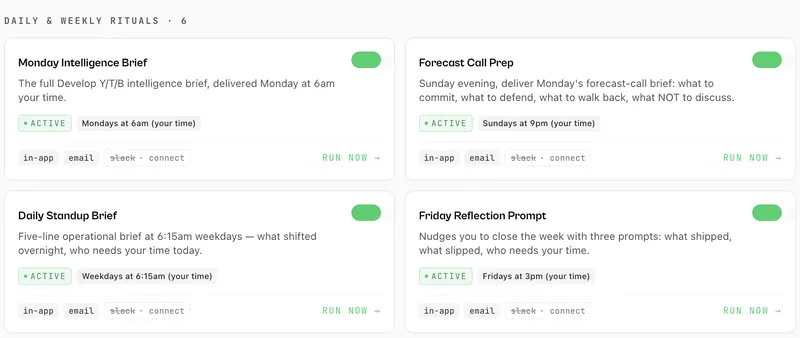
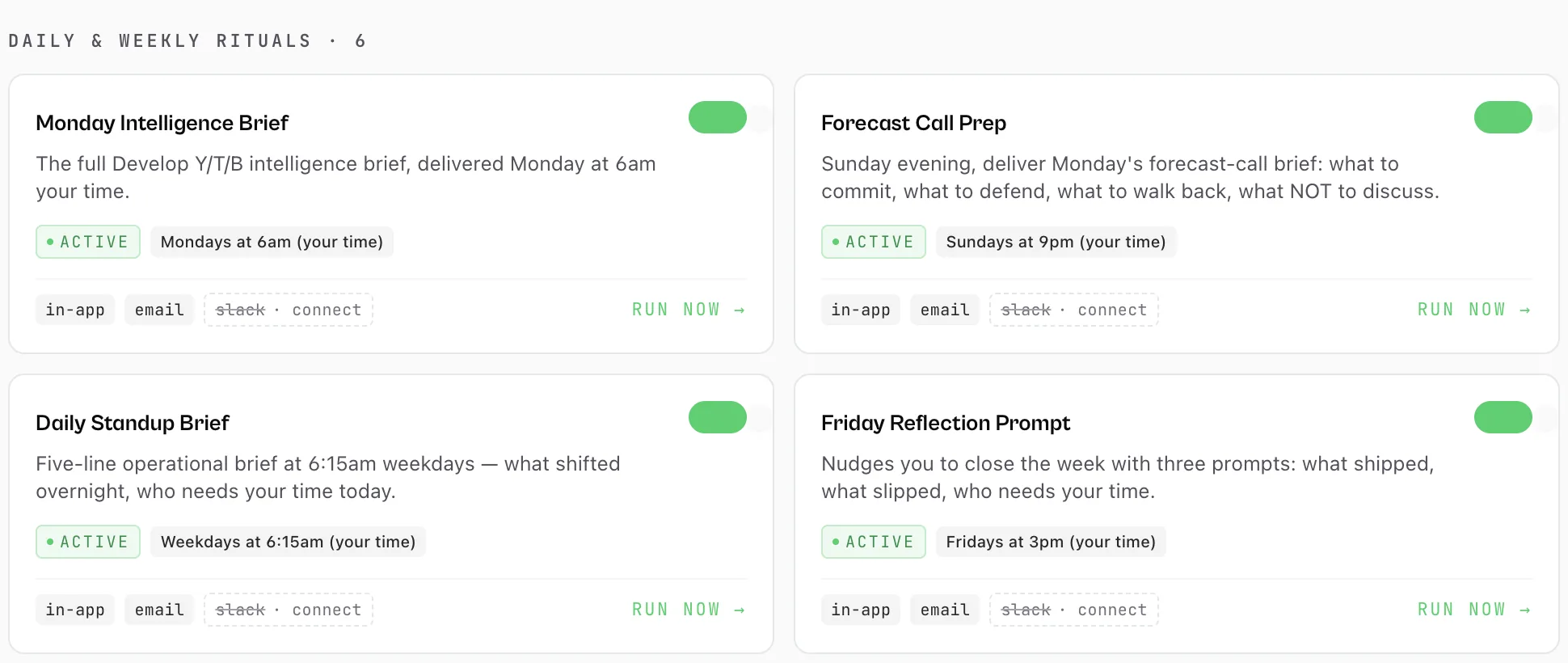
Automations · Daily and weekly rituals
Enlarge
Live product
The shift nobody assigned you
You know this sequence by heart.
10:47 PM
You open the CRM “just to check.” You both know it isn't a check.
11:12 PM
The scroll. Forty deals, and you run the gut-math on every one: which numbers are real, which are hope with a close date.
11:38 PM
The Monday plan writes itself in your head. Talk to Sarah about the TechFlow deal, chase the Meridian thread, ask why the demos stalled. Nothing gets written down. It never does.
12:05 AM
The tab stays open. You go to bed with the number.
Nobody assigned you this shift. It's just the only hour quiet enough to hear the pipeline. And it still misses things, because tired pattern-matching at midnight is what a leader does when there is no system.
The same review, on a schedule
Can software run the Sunday night pipeline review?
Yes. It runs on a schedule in your time zone, so the review is done before you would open the CRM. Here is when each part lands.
Sundays at 9 p.m.
Forecast Call Prep. If you still want Sunday, keep it to this one read: what to commit, what to defend, what to walk back and what to leave off Monday's call.
Mondays at 6 a.m.
The Monday brief. Your business, your team and your own week, with the work drafted.
Weekdays at 6 a.m., in your 7 a.m. digest
Stalled deals and silent champions. Checked by the same rule every week: a deal with no activity in 10 days, and a champion silent for a week.
Mondays at 9 a.m.
Thin deals and slip patterns. Checked by the same rule every week: one of your ten largest deals with fewer than three people engaged, and three or more deals slipping in one week.
Fridays at 3 p.m.
Your Friday reflection. Three prompts to close your own week: what shipped, what slipped and who needs your time. The week closes on Friday afternoon instead of Sunday night.
The plan that used to live in your head
The midnight to-do list becomes a morning agenda.
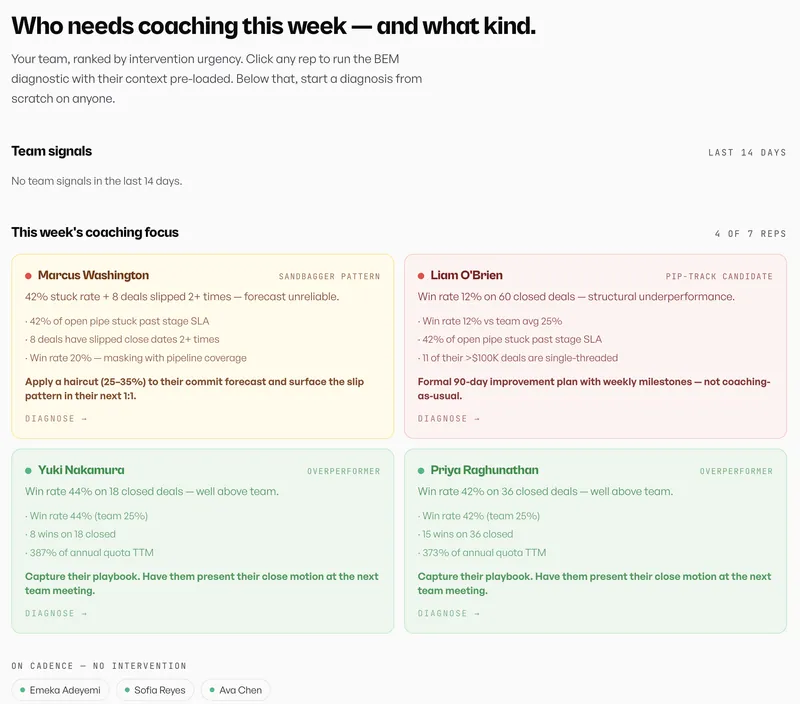
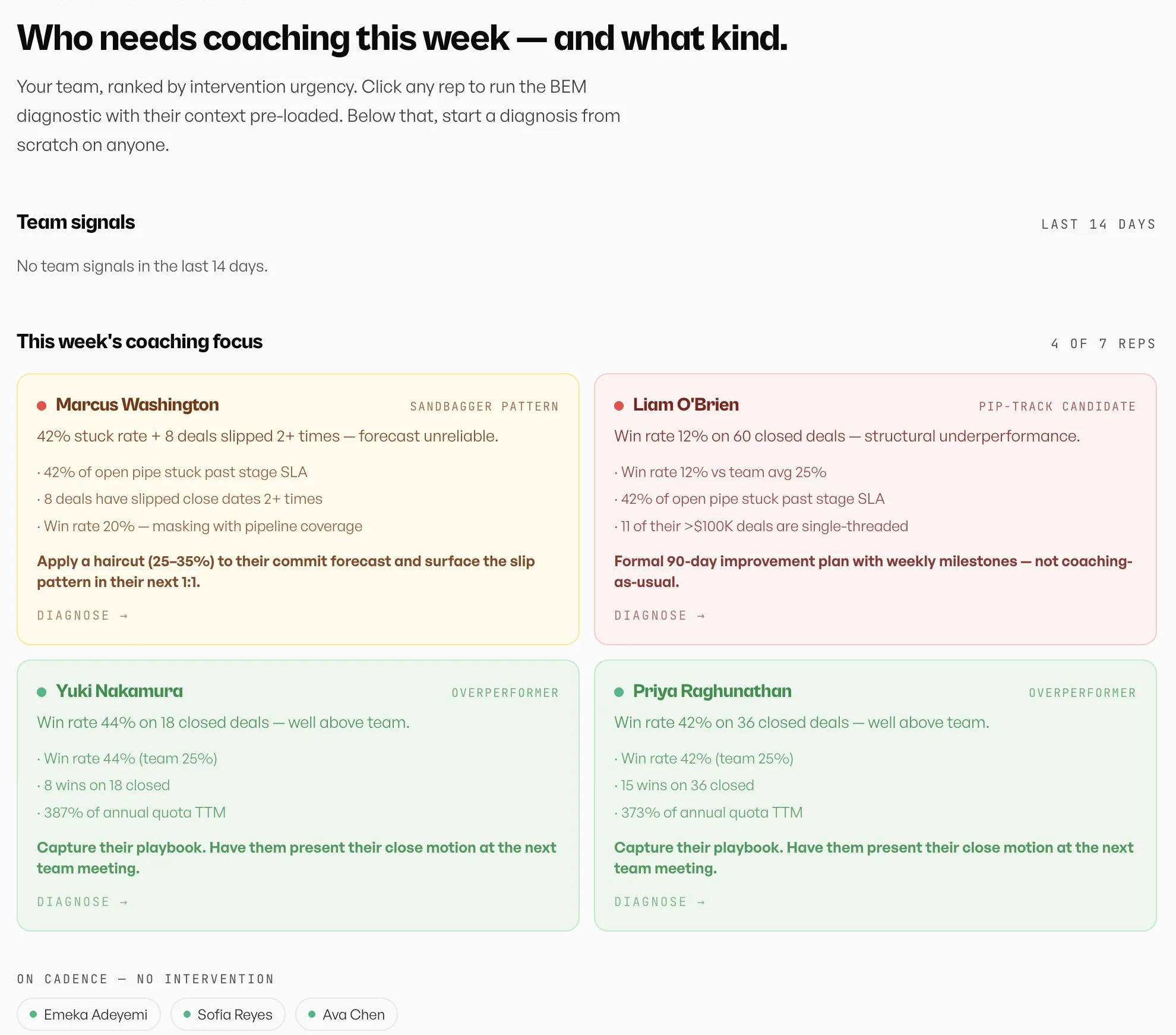
At 11:38 you planned to talk to Sarah about TechFlow. Monday's list names who to talk to, why, and what to say, ranked by urgency. Left to Sunday night, Marcus's commit goes into the call as he called it; the read says it can't be trusted as called.
Coaching · This week's coaching focus
Enlarge
Live product
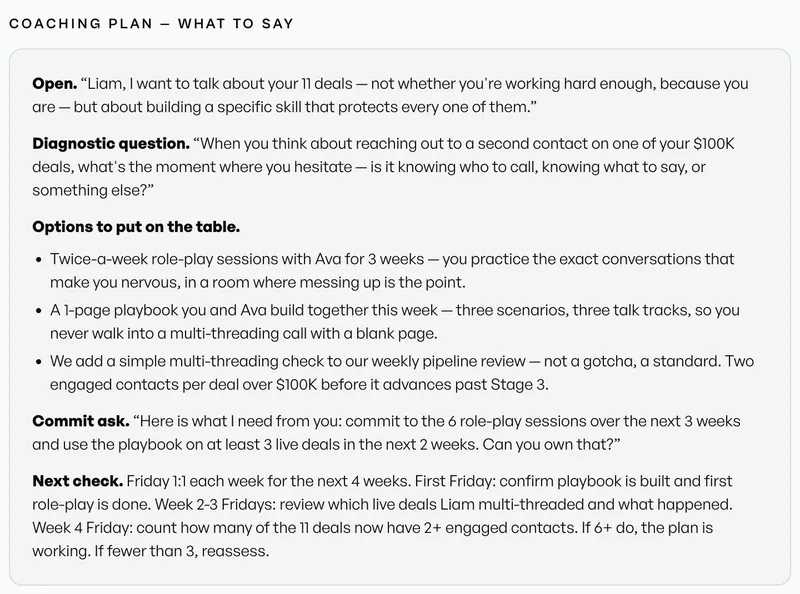
And what to say
The first 1:1 is drafted before you walk in.
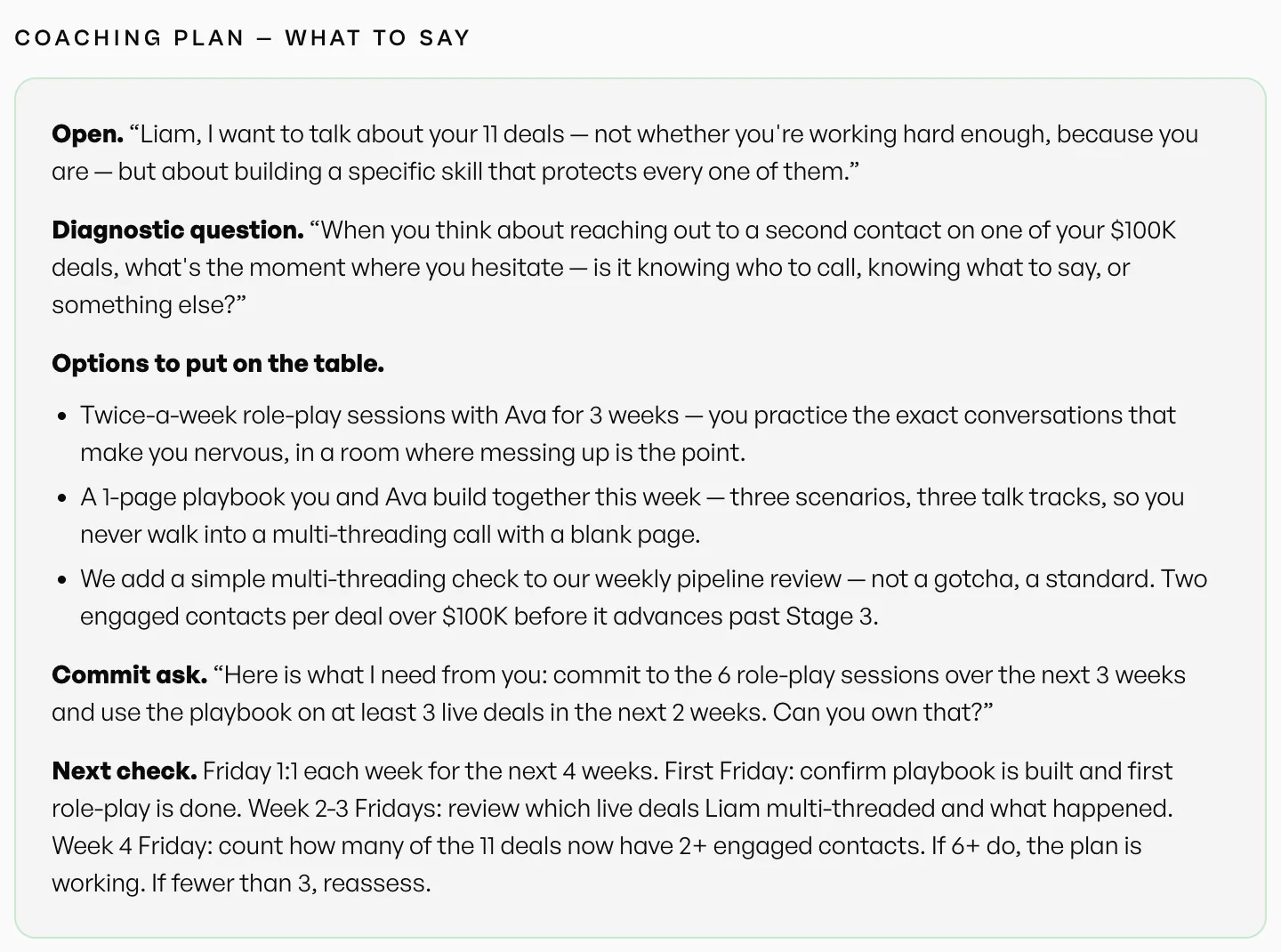
Coaching · Coaching plan · What to say
Enlarge
Live product
Signal
Four of seven reps need a different kind of attention this week.
Interpretation
Marcus's forecast can't be trusted as called. Liam's gap is structural, not a bad month.
The move
Haircut Marcus's commit by 25 to 35% and raise the slips in his 1:1. Put Liam on a 90-day plan with weekly milestones. Ask Yuki and Priya to present their close motion.
Drafted: the open
Talk about his 11 deals and one specific skill, not about effort.
Drafted: the options
Twice-weekly role-plays for three weeks, a one-page playbook, and a two-contact check in the pipeline review.
Every screen here is the live product, on our demo workspace, Cipher Atlas. Its CRM uses real company names as accounts; none of those companies is a Management OS customer.
A report versus a brief
Isn't a saved CRM report enough?
No. A saved report lists the deals that match your filter. Management OS checks your pipeline by the same rules every week, says why each deal was flagged, and drafts the move.
Feature
A saved CRM report
Your Sunday review
Management OS
Which deals changed
The ones that match the filter you saved
The ones you notice at midnight
Each deal that tripped a rule this week
Why it matters
Not shown
Your gut read, tired
The reason on every item, with a “Why am I seeing this?” link
The move
Left to you
A plan in your head, never written down
The play drafted and the 1:1s ranked
What it costs you
A filter to keep current
Sunday night, from 10:47 to past midnight
Nothing to open: the brief is waiting at 6 a.m.
An AI assistant could do this if you asked it every Sunday. This one runs without being asked.
Proven by hand before it was software
Twenty years of Sunday nights came first.
Jason Mesiarik spent twenty years leading revenue teams and training the people who run them. Management OS runs the review he did by hand, on your own data, before Monday.
Results Jason led as an operator, using the method Management OS now runs. They are his results, not Management OS customer results.
Read-only to your CRM. Management OS never creates, changes or deletes a CRM record. No training on customer data. Trust & Security · Sub-processors · DPA
The trial, in plain language
30 days. Free. The next Sunday is optional.
Hand the hunting to software and keep the decisions. Connect your CRM, read-only, in about 5 minutes and read your first brief about 15 minutes in. Next Sunday at 11 p.m. there is nothing to open.
See your own Monday brief before next Sunday.
30 days free on the full package, with your team and your data, priced by the people you manage, not by seat.
Card required. Cancel before day 30 and pay nothing.
How does Management OS cut the Sunday-night pipeline review?
It runs the review on a schedule. Forecast Call Prep lands Sundays at 9 p.m., and by 6 a.m. Monday the brief shows which deals slipped and why, who needs coaching and the play, already drafted.
Will it catch what I'd catch on a Sunday?
It checks your pipeline by the same rules every week: a deal with no activity in 10 days and a champion silent for a week (weekdays at 6 a.m., in your 7 a.m. digest); one of your ten largest deals with fewer than three people engaged and three or more deals slipping in one week (Mondays at 9 a.m.). Each item says why it was flagged, so you can check it against your own read.
I already have dashboards and Gong. Why this?
Keep them. Gong reads your calls and a dashboard shows where each deal sits; Management OS reads your CRM, calendar and email, plus your Gong recordings if you connect it, and hands you who needs you this week with the move drafted.
I run managers, not reps. Does it still work?
Yes, on Org: you plus up to 10 people, any mix of managers and reps, and everyone in scope gets their own desk at no seat charge. The same rules run every week on the pipeline you lead.
Does it change my CRM?
Read-only to your CRM. Management OS never creates, changes or deletes a CRM record.
How long does setup take?
Connect your CRM in about 5 minutes. Your first brief lands in about 15 minutes. Card required. Cancel before day 30 and pay nothing.
What does it cost after the trial?
After 30 days the trial becomes the package you chose at checkout, unless you cancel before then. Leader, for you plus up to 3 people you manage, is $1,250 a month, or $12,000 a year billed yearly. Team and Org cover more people, and every package is on the pricing page.
On day 30 the trial becomes the package and billing you chose at sign-up, unless you cancel: from $1,000 a month billed yearly, or $1,250 billed monthly. See every package.