Ninety days to turn an inherited number into one you can defend to the board.
You answer to a CEO, a CFO and a board for a number someone else forecast. Every Monday the brief reads your CRM, calendar and team, and names the deals that need you and who to coach first.
The sales management operating system built for leaders and used by their teams: insights, coaching and actions to develop yourself, your team and your business.
Before you change things, learn what's true: week one on the CRM you inherited, who needs coaching every week, the board update in week twelve. Watch on YouTube (opens in a new tab)
Companies with a formal sales process reported 18% higher revenue growth than companies without one. Harvard Business Review, 2015
Read the transcript: Your First 100 Days as CRO: Learn What's True First
0:00 The title is yours. So is the number.
Congratulations, you're the new CRO. The title is yours. So is the number. But the forecast, someone else built it. The team, you're still getting to know them. And the CEO and the board already want answers. The temptation is to prove yourself immediately. Rewrite the forecast, overhaul the team and rescue every deal.
0:25 Before you change things, learn what's true
I've carried that responsibility. Here's what I've learned: before you change things, learn what's true.
0:34 Week one: connect the CRM you inherited
In week one, connect the CRM you inherited. When the deal marked Commit has no buyer-confirmed next step, Management OS flags that risk, shows you the evidence and recommends what to do next.
0:46 Every week: who needs coaching
With each week, you're looking beyond quota attainment. You see who needs coaching, what managers need support, and how to prepare for the conversations that matter.
0:56 Week twelve: the board update
And by week 12, your board update isn't a collection of hopeful slides. It's what you verified, what's at risk, and what you are doing about it.
1:05 Day 100: a rhythm your team can repeat
And by day 100, you're not just working harder. You're building a leadership rhythm your team can repeat. I built Management OS for the person carrying the number. Start your brief.
From the founder
I've walked into your seat five times: a messy CRM, no playbook and a 90-day clock. The first time, my operating system was a spreadsheet and a prayer. Since then I've run forecast calls with 10,000 sellers and forecast calls with five, and the pain is the same. You don't actually know what's real. So in the first 90 days, learn what's true first: which deals the evidence supports, which managers can coach without you in the room, and what you can honestly put in front of the board.
Jason Mesiarik
Week 1 · Know what's real
Which of the forecast calls you inherited can you repeat to the board?
Only the ones the evidence supports.
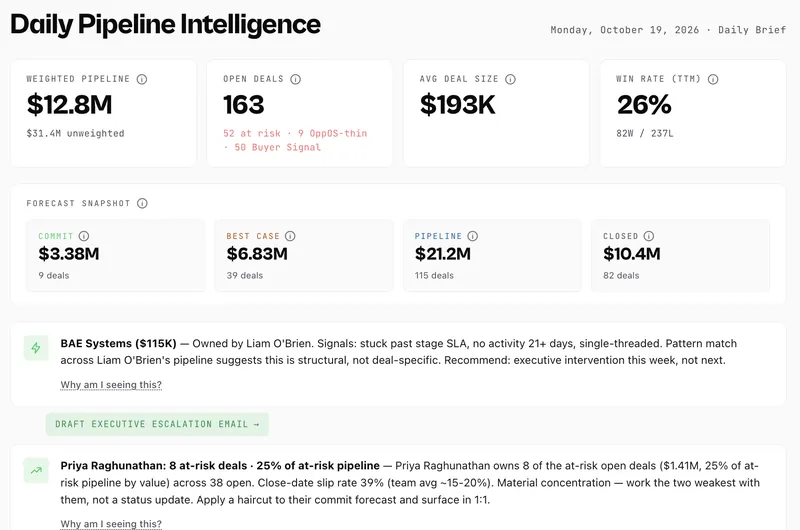
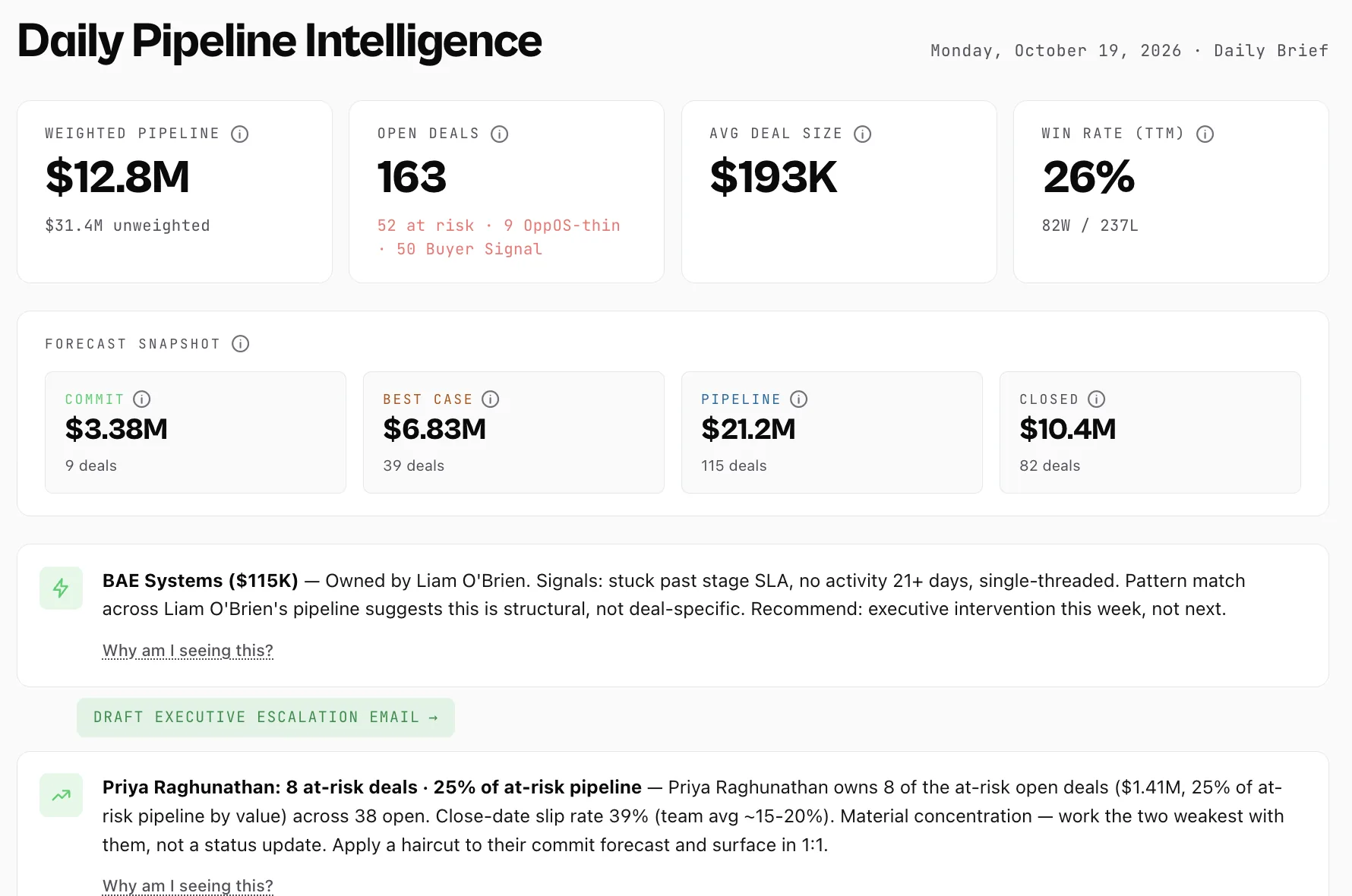
Desk · Develop Your Business · Daily Brief
Enlarge
Live productStep into the deal that needs you while it can still be saved.
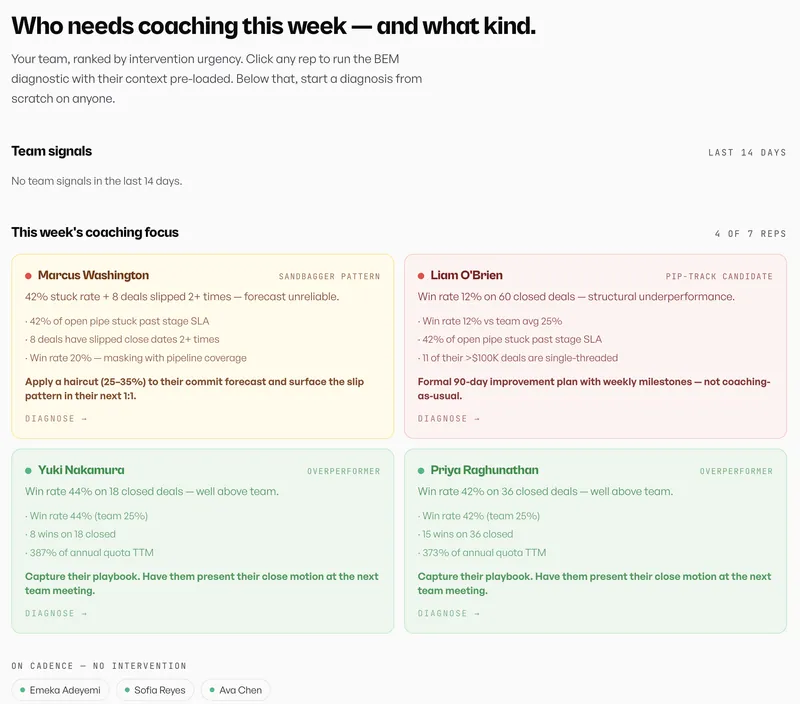
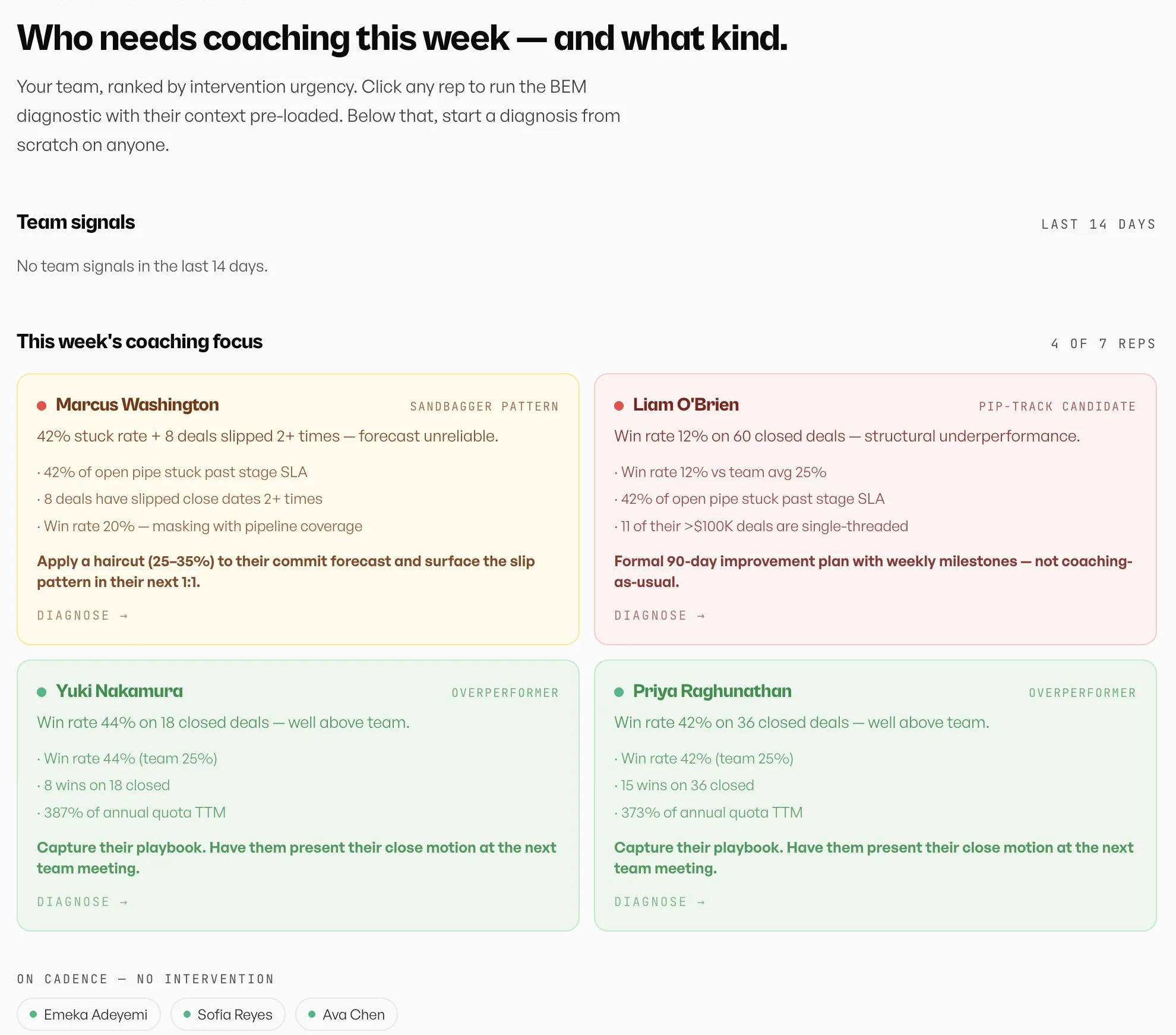
Coaching · This week's coaching focus
Enlarge
Live productMarcus's forecast is corrected before the board ever sees it.
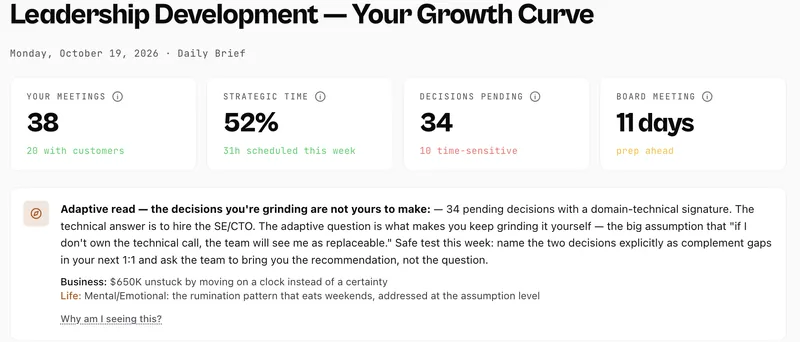
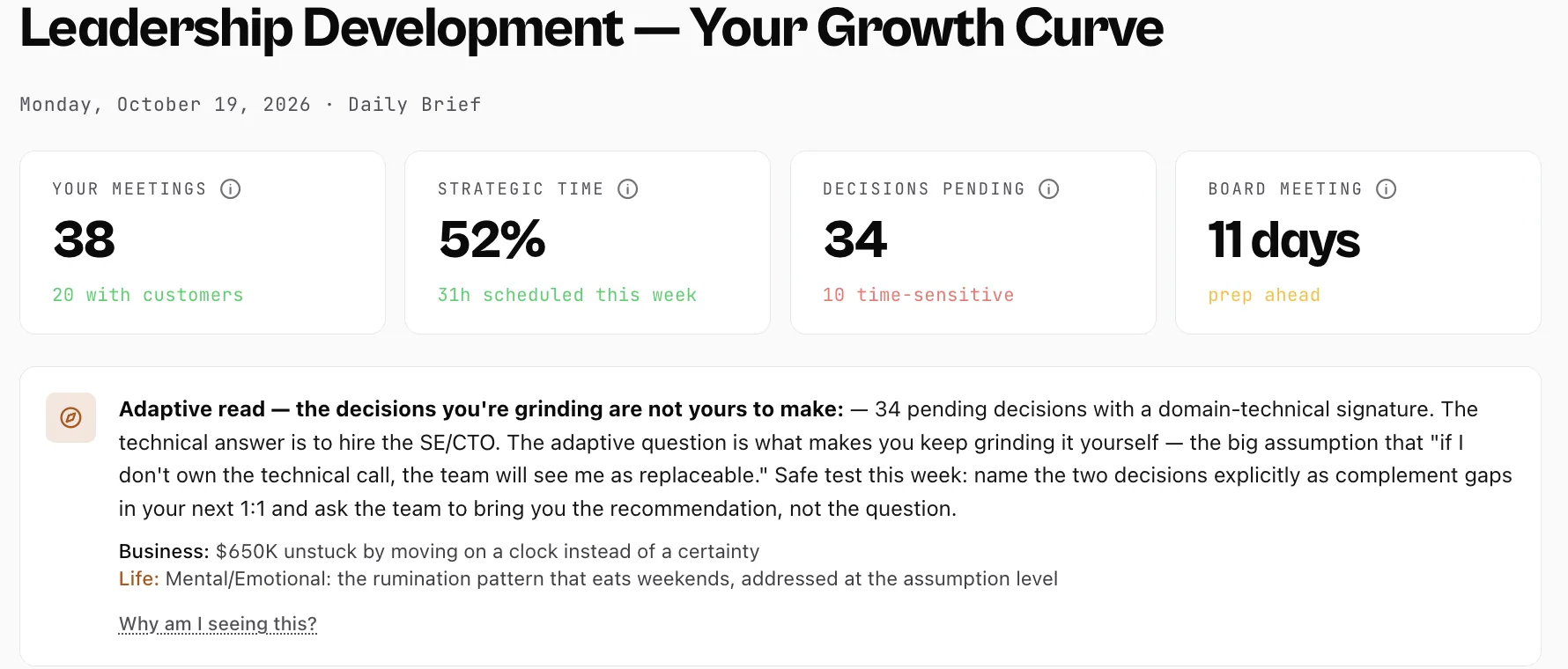
Desk · Develop Yourself · Daily Brief
Enlarge
Live productYou hand two calls back to your team and keep the hours for the board.
Every screen here is the live product, on our demo workspace, Cipher Atlas. Its CRM uses real company names as accounts; none of those companies is a Management OS customer.
Week 4 · Coach through your managers
Why Liam's big deals stay single-threaded, and what to say on Friday.
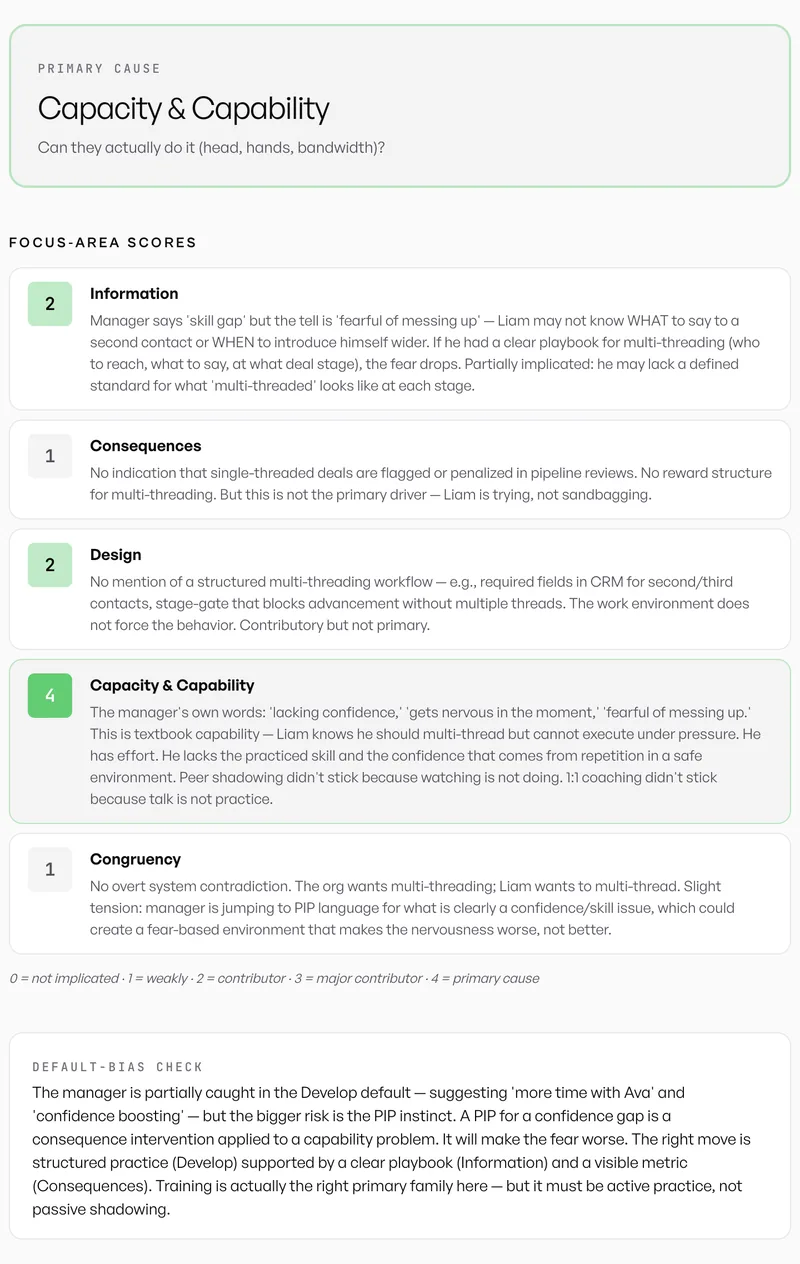
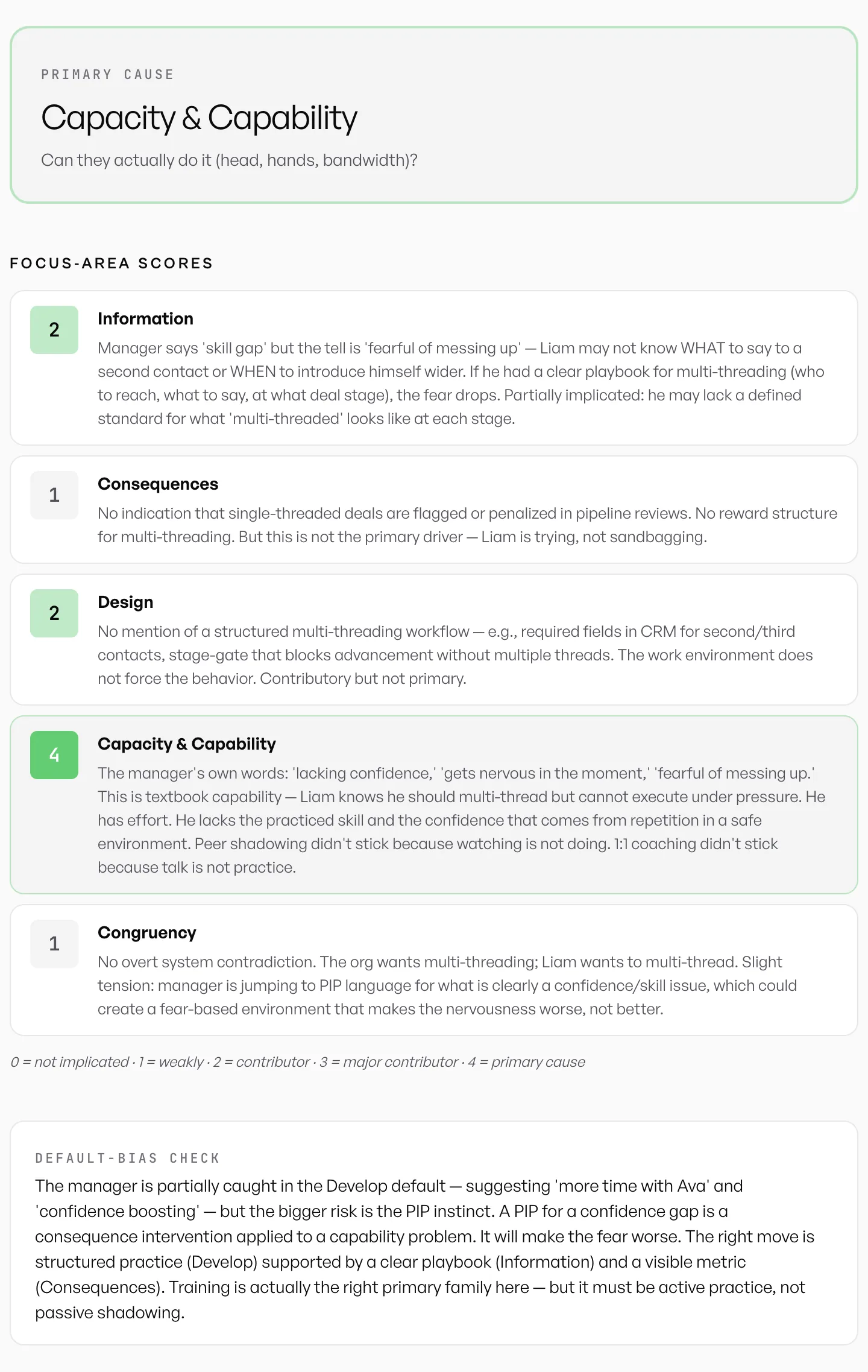
Coaching · BEM diagnosis · Liam O'Brien
Enlarge
Live productYou keep a rep who is trying and coach the one skill he's missing.Read this screen: Coaching · BEM diagnosis · Liam O'Brien
Primary cause: Capacity & Capability. Can they actually do it (head, hands, bandwidth)?
Focus-area scores.
2 · Information. Manager says 'skill gap' but the tell is 'fearful of messing up' — Liam may not know WHAT to say to a second contact or WHEN to introduce himself wider. If he had a clear playbook for multi-threading (who to reach, what to say, at what deal stage), the fear drops. Partially implicated: he may lack a defined standard for what 'multi-threaded' looks like at each stage.
1 · Consequences. No indication that single-threaded deals are flagged or penalized in pipeline reviews. No reward structure for multi-threading. But this is not the primary driver — Liam is trying, not sandbagging.
2 · Design. No mention of a structured multi-threading workflow — e.g., required fields in CRM for second/third contacts, stage-gate that blocks advancement without multiple threads. The work environment does not force the behavior. Contributory but not primary.
4 · Capacity & Capability. The manager's own words: 'lacking confidence,' 'gets nervous in the moment,' 'fearful of messing up.' This is textbook capability — Liam knows he should multi-thread but cannot execute under pressure. He has effort. He lacks the practiced skill and the confidence that comes from repetition in a safe environment. Peer shadowing didn't stick because watching is not doing. 1:1 coaching didn't stick because talk is not practice.
1 · Congruency. No overt system contradiction. The org wants multi-threading; Liam wants to multi-thread. Slight tension: manager is jumping to PIP language for what is clearly a confidence/skill issue, which could create a fear-based environment that makes the nervousness worse, not better.
0 = not implicated · 1 = weakly · 2 = contributor · 3 = major contributor · 4 = primary cause
Default-bias check. The manager is partially caught in the Develop default — suggesting 'more time with Ava' and 'confidence boosting' — but the bigger risk is the PIP instinct. A PIP for a confidence gap is a consequence intervention applied to a capability problem. It will make the fear worse. The right move is structured practice (Develop) supported by a clear playbook (Information) and a visible metric (Consequences). Training is actually the right primary family here — but it must be active practice, not passive shadowing.
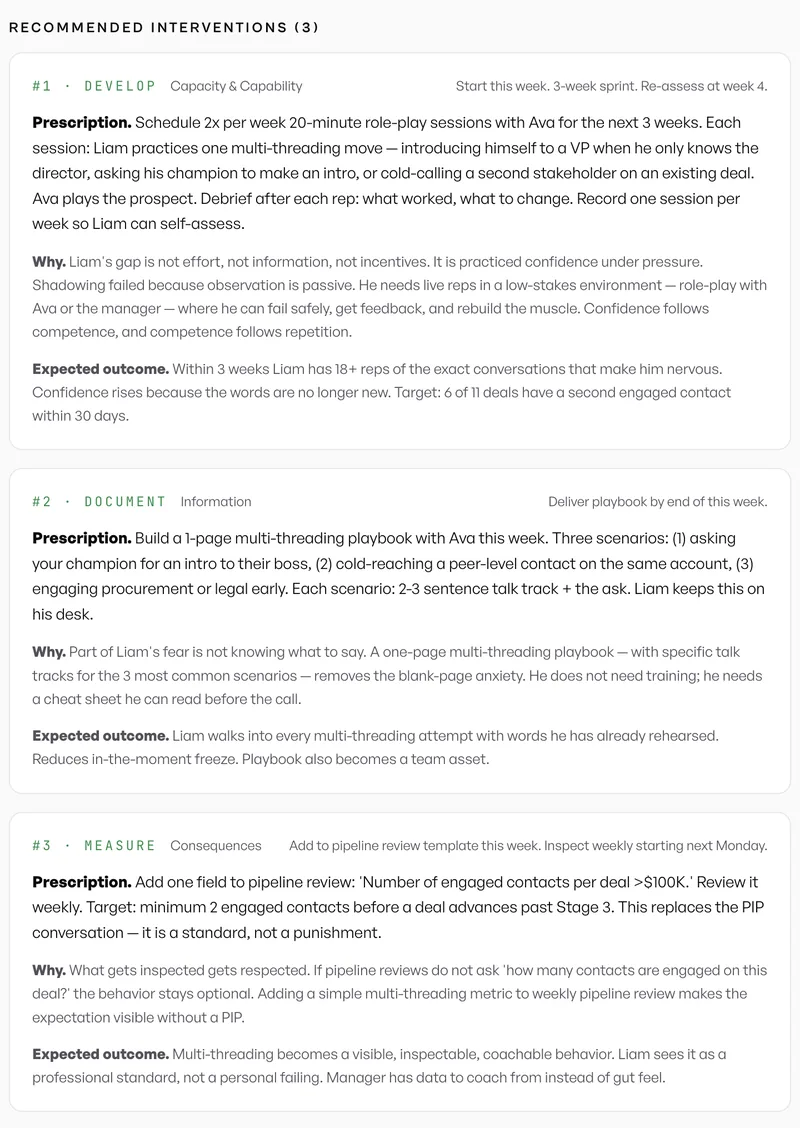
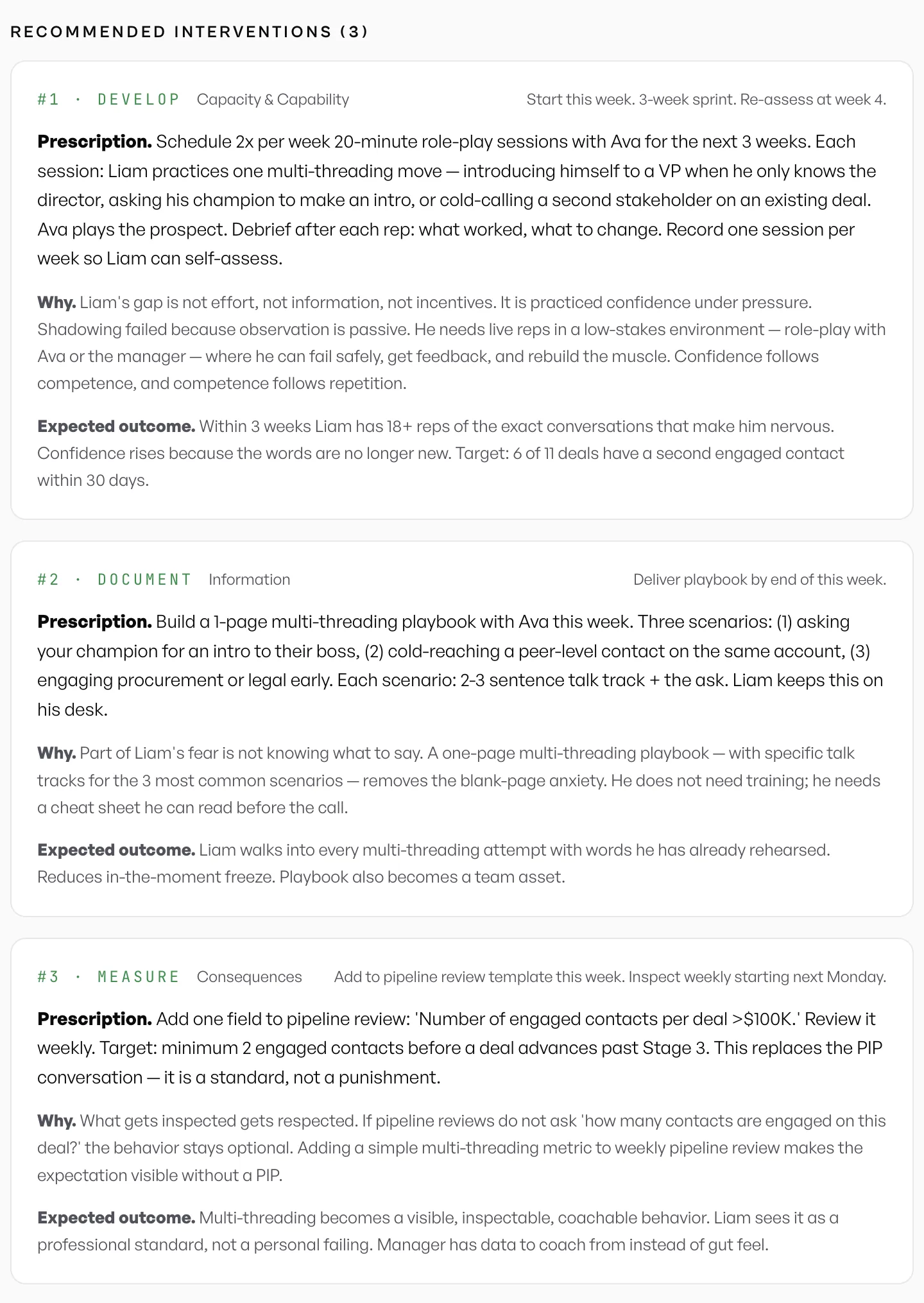
Live productEach move comes with a start date and an expected outcome to check it against.Read this screen: Coaching · Recommended interventions · Liam O'Brien
Recommended interventions (3).
#1 · Develop (Capacity & Capability). Start this week. 3-week sprint. Re-assess at week 4.
Prescription. Schedule 2x per week 20-minute role-play sessions with Ava for the next 3 weeks. Each session: Liam practices one multi-threading move — introducing himself to a VP when he only knows the director, asking his champion to make an intro, or cold-calling a second stakeholder on an existing deal. Ava plays the prospect. Debrief after each rep: what worked, what to change. Record one session per week so Liam can self-assess.
Why. Liam's gap is not effort, not information, not incentives. It is practiced confidence under pressure. Shadowing failed because observation is passive. He needs live reps in a low-stakes environment — role-play with Ava or the manager — where he can fail safely, get feedback, and rebuild the muscle. Confidence follows competence, and competence follows repetition.
Expected outcome. Within 3 weeks Liam has 18+ reps of the exact conversations that make him nervous. Confidence rises because the words are no longer new. Target: 6 of 11 deals have a second engaged contact within 30 days.
#2 · Document (Information). Deliver playbook by end of this week.
Prescription. Build a 1-page multi-threading playbook with Ava this week. Three scenarios: (1) asking your champion for an intro to their boss, (2) cold-reaching a peer-level contact on the same account, (3) engaging procurement or legal early. Each scenario: 2-3 sentence talk track + the ask. Liam keeps this on his desk.
Why. Part of Liam's fear is not knowing what to say. A one-page multi-threading playbook — with specific talk tracks for the 3 most common scenarios — removes the blank-page anxiety. He does not need training; he needs a cheat sheet he can read before the call.
Expected outcome. Liam walks into every multi-threading attempt with words he has already rehearsed. Reduces in-the-moment freeze. Playbook also becomes a team asset.
#3 · Measure (Consequences). Add to pipeline review template this week. Inspect weekly starting next Monday.
Prescription. Add one field to pipeline review: 'Number of engaged contacts per deal >$100K.' Review it weekly. Target: minimum 2 engaged contacts before a deal advances past Stage 3. This replaces the PIP conversation — it is a standard, not a punishment.
Why. What gets inspected gets respected. If pipeline reviews do not ask 'how many contacts are engaged on this deal?' the behavior stays optional. Adding a simple multi-threading metric to weekly pipeline review makes the expectation visible without a PIP.
Expected outcome. Multi-threading becomes a visible, inspectable, coachable behavior. Liam sees it as a professional standard, not a personal failing. Manager has data to coach from instead of gut feel.
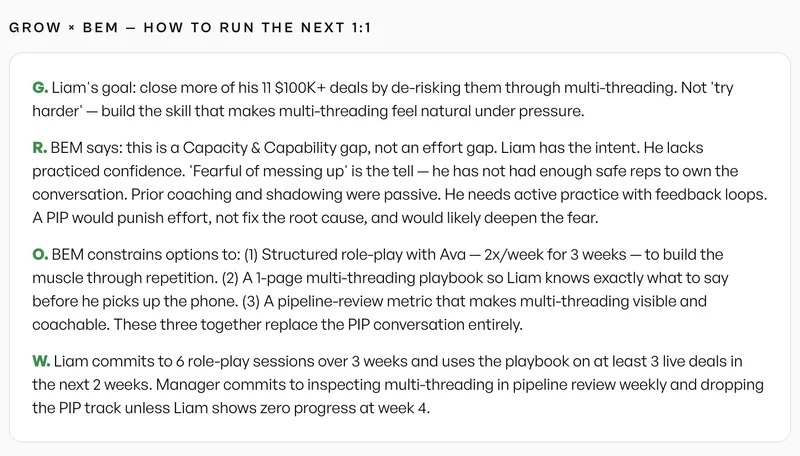
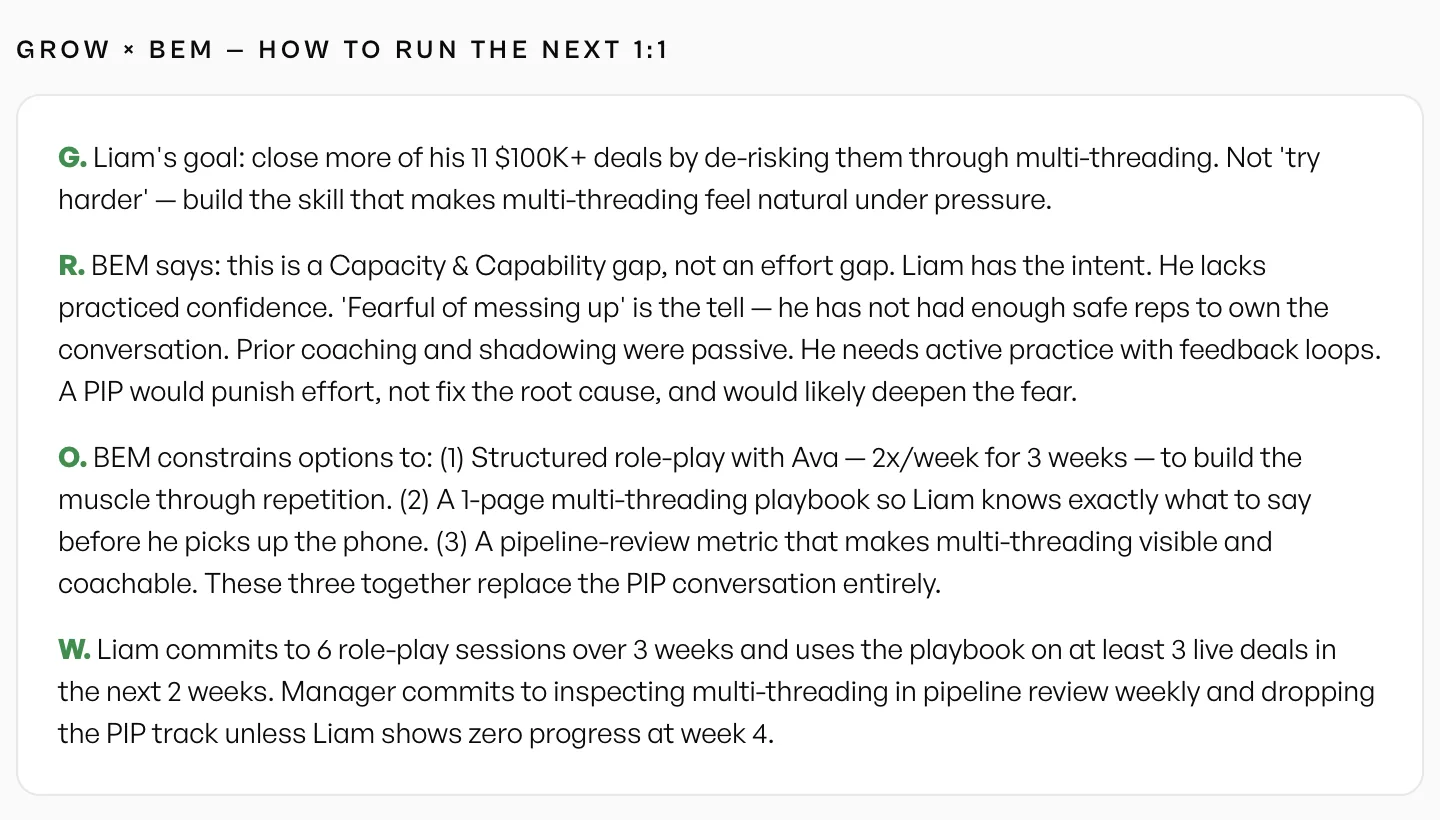
Coaching · GROW × BEM · How to run the next 1:1
Enlarge
Live productWalk in knowing how the conversation should end, and when you'll check it.Read this screen: Coaching · GROW × BEM · How to run the next 1:1
GROW × BEM: how to run the next 1:1.
G. Liam's goal: close more of his 11 $100K+ deals by de-risking them through multi-threading. Not 'try harder' — build the skill that makes multi-threading feel natural under pressure.
R. BEM says: this is a Capacity & Capability gap, not an effort gap. Liam has the intent. He lacks practiced confidence. 'Fearful of messing up' is the tell — he has not had enough safe reps to own the conversation. Prior coaching and shadowing were passive. He needs active practice with feedback loops. A PIP would punish effort, not fix the root cause, and would likely deepen the fear.
O. BEM constrains options to: (1) Structured role-play with Ava — 2x/week for 3 weeks — to build the muscle through repetition. (2) A 1-page multi-threading playbook so Liam knows exactly what to say before he picks up the phone. (3) A pipeline-review metric that makes multi-threading visible and coachable. These three together replace the PIP conversation entirely.
W. Liam commits to 6 role-play sessions over 3 weeks and uses the playbook on at least 3 live deals in the next 2 weeks. Manager commits to inspecting multi-threading in pipeline review weekly and dropping the PIP track unless Liam shows zero progress at week 4.
Coaching · Coaching plan · What to say
Enlarge
Live productYou never have to improvise the hardest conversation of your week.Read this screen: Coaching · Coaching plan · What to say
Coaching plan: what to say.
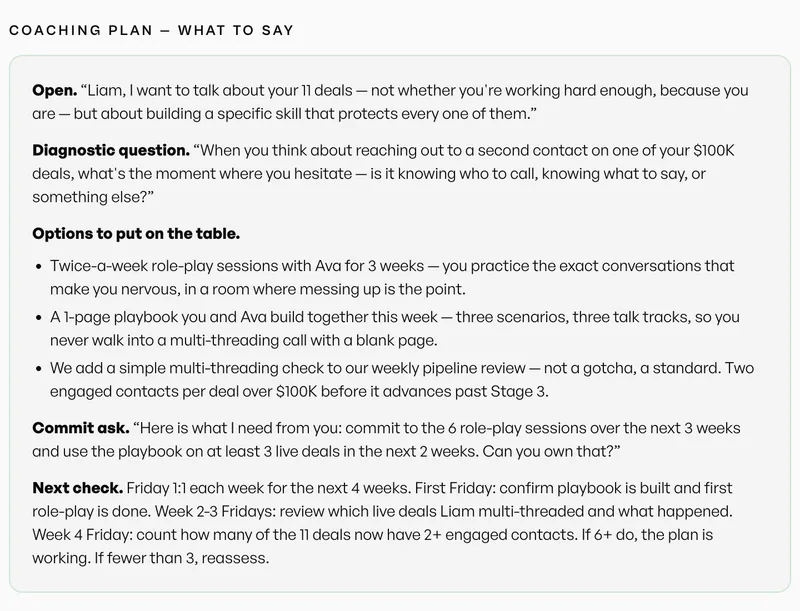
Open. “Liam, I want to talk about your 11 deals — not whether you're working hard enough, because you are — but about building a specific skill that protects every one of them.”
Diagnostic question. “When you think about reaching out to a second contact on one of your $100K deals, what's the moment where you hesitate — is it knowing who to call, knowing what to say, or something else?”
Options to put on the table. Twice-a-week role-play sessions with Ava for 3 weeks — you practice the exact conversations that make you nervous, in a room where messing up is the point. A 1-page playbook you and Ava build together this week — three scenarios, three talk tracks, so you never walk into a multi-threading call with a blank page. We add a simple multi-threading check to our weekly pipeline review — not a gotcha, a standard. Two engaged contacts per deal over $100K before it advances past Stage 3.
Commit ask. “Here is what I need from you: commit to the 6 role-play sessions over the next 3 weeks and use the playbook on at least 3 live deals in the next 2 weeks. Can you own that?”
Next check. Friday 1:1 each week for the next 4 weeks. First Friday: confirm playbook is built and first role-play is done. Week 2-3 Fridays: review which live deals Liam multi-threaded and what happened. Week 4 Friday: count how many of the 11 deals now have 2+ engaged contacts. If 6+ do, the plan is working. If fewer than 3, reassess.
Watch
The renewal your forecast counts on, gone quiet.
Jason walks it through the live product on our demo workspace, with highlights added for the film.
A renewal the forecast counts on, one contact in the account, weeks of silence. The brief names the three moves before your forecast call. Watch on YouTube (opens in a new tab)
Won deals carry twice the buyer contacts of lost deals; multi-threading lifts win rates 130% on deals over $50K. Gong Labs, 2026
Read the transcript: Your Forecast Says Yes. Your Customer Says Nothing.
You ever have one of those deals that everyone thought was safe but went a little sideways? So your forecast says the renewal is coming in but the customer hasn't said a word in weeks. But how would you know? Let me show you how you see this through Management OS. So here every day it's giving you the action queue. Here we see the executive brief on AIG. They renew but we've got a competitor moving in and we've got to move on this renewal, protect that revenue. So click on the executive brief here. It's giving us some quick background on the relationship and pipelines. What's changed? Here we can see the install is days away. We've got no signed paper, no verbal commitment logged. We know that they're evaluating a competitor here, so what are we going to do about this? We've got three moves. Get the renewal committed, close off the competitor, and we're going to keep the other deal that we have currently in motion, a new deal, we're going to keep that separate from the renewal. So how are we going to move on this? First step, Emeka gets that 30-minute meeting with the CISO on the calendar and cover three things. Renewal commitment, no cost, discover baseline for their other business unit, and we get an introduction to that other business unit security lead. If we don't get that response, then we're escalating. So what we're doing here is we're laying out each of the steps, not one at a time, but we're really focused on how we manage the account at large. This is the difference in Management OS. It's built for enterprise grade.
Behind each move
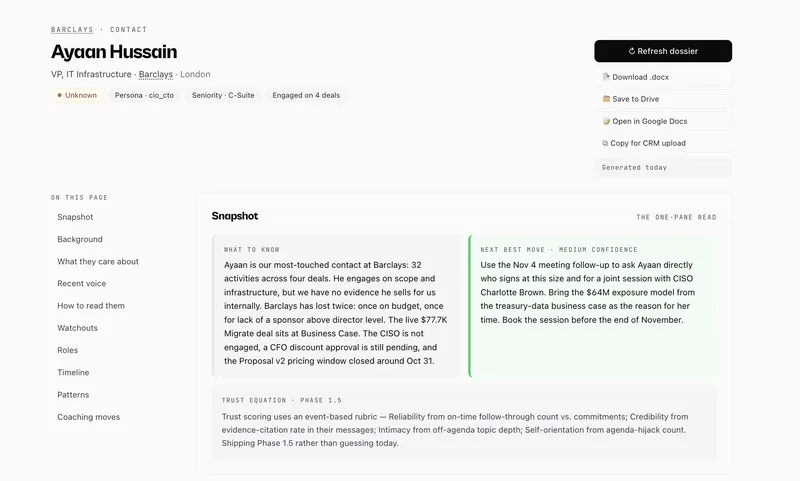
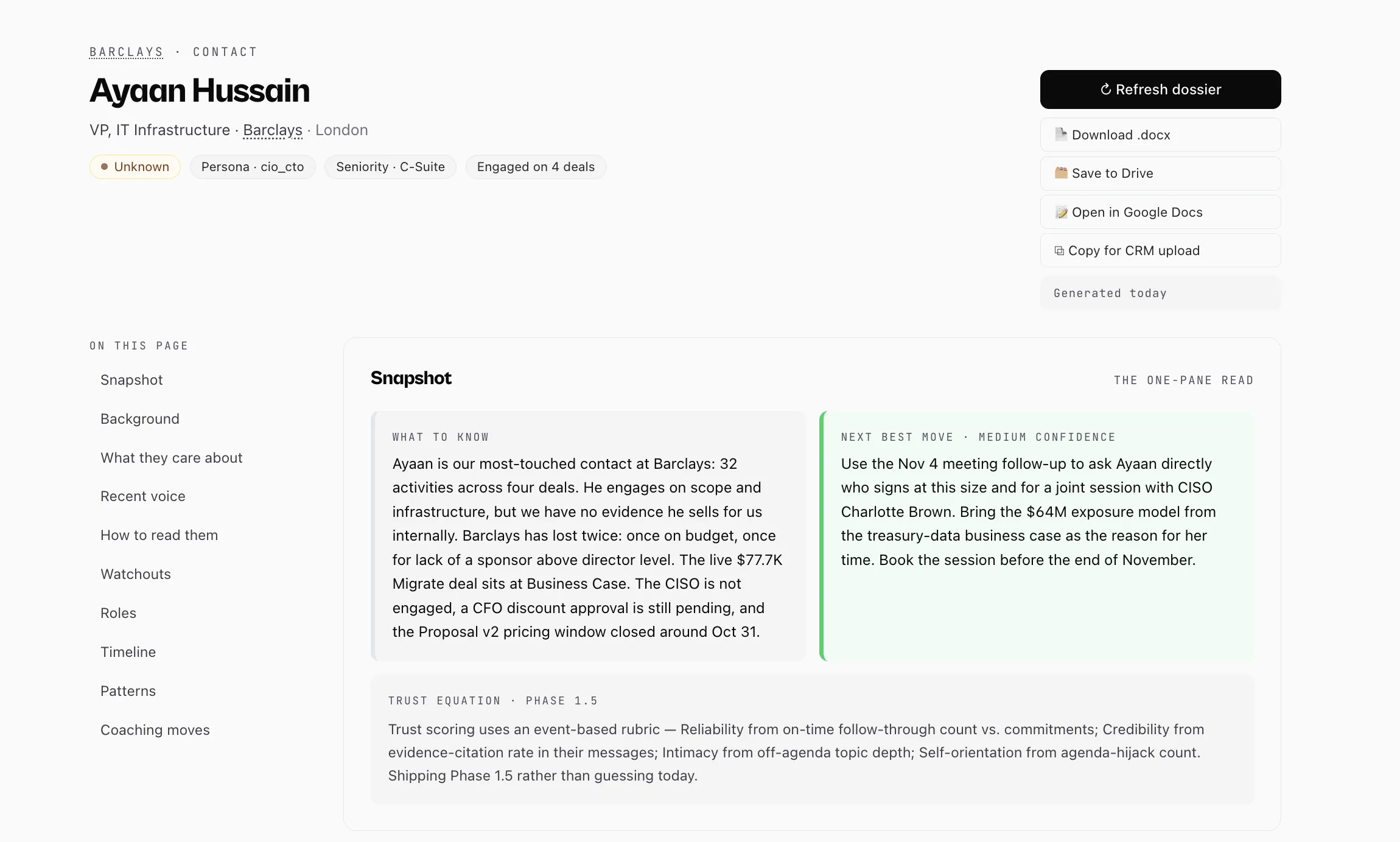
Contacts · Dossier · Ayaan Hussain
Enlarge
Live product
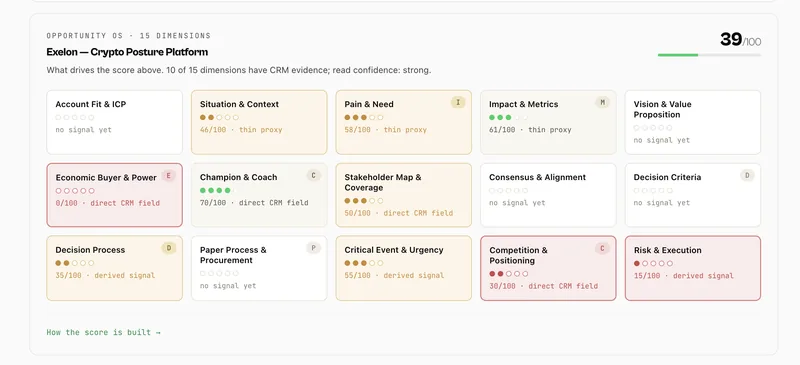
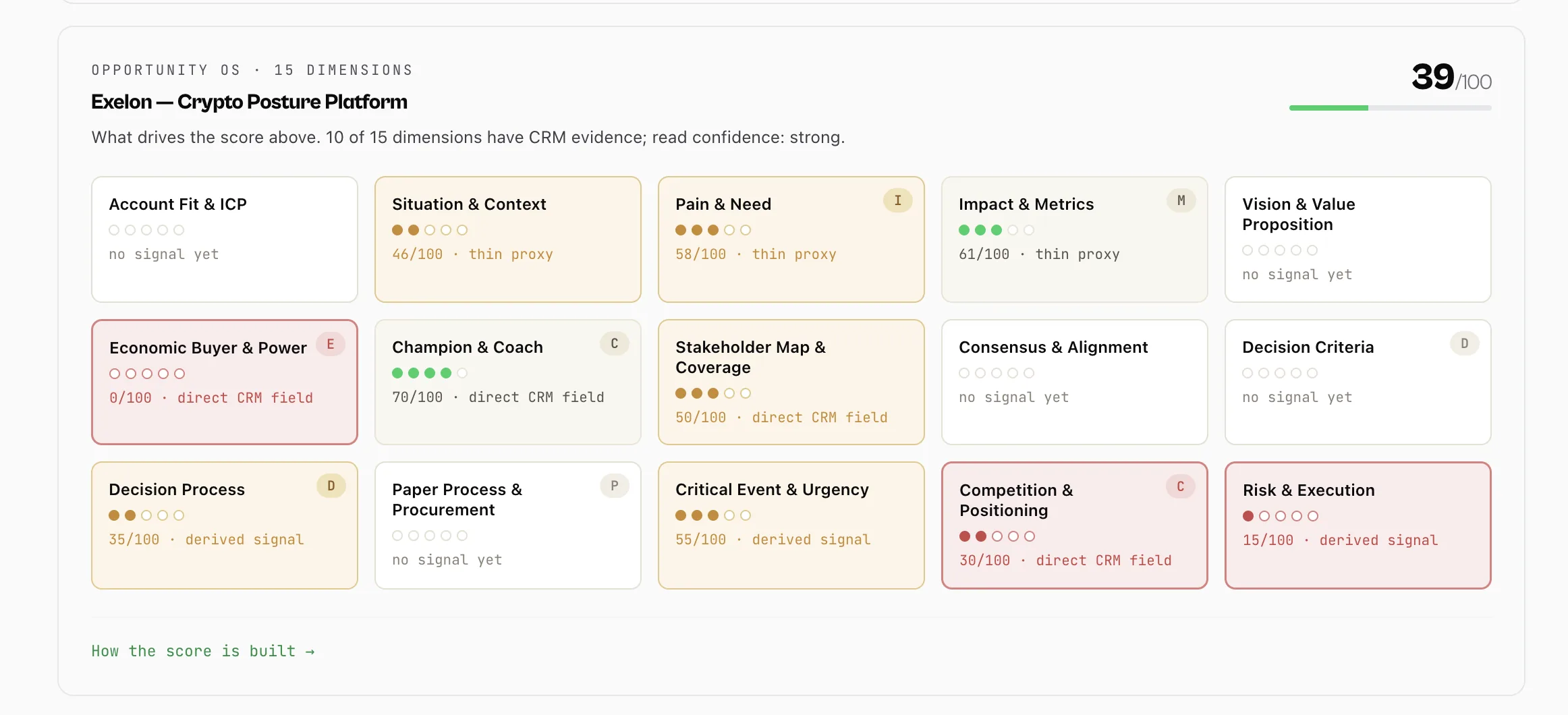
Opportunity OS · 15 dimensions
Enlarge
Live product
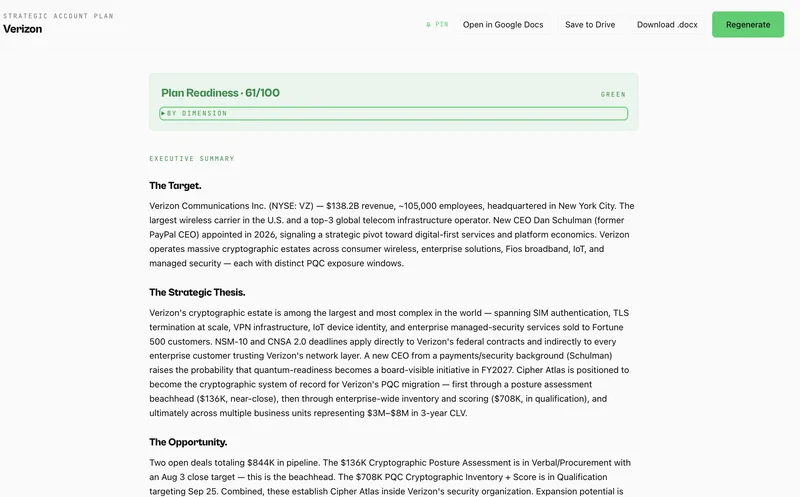
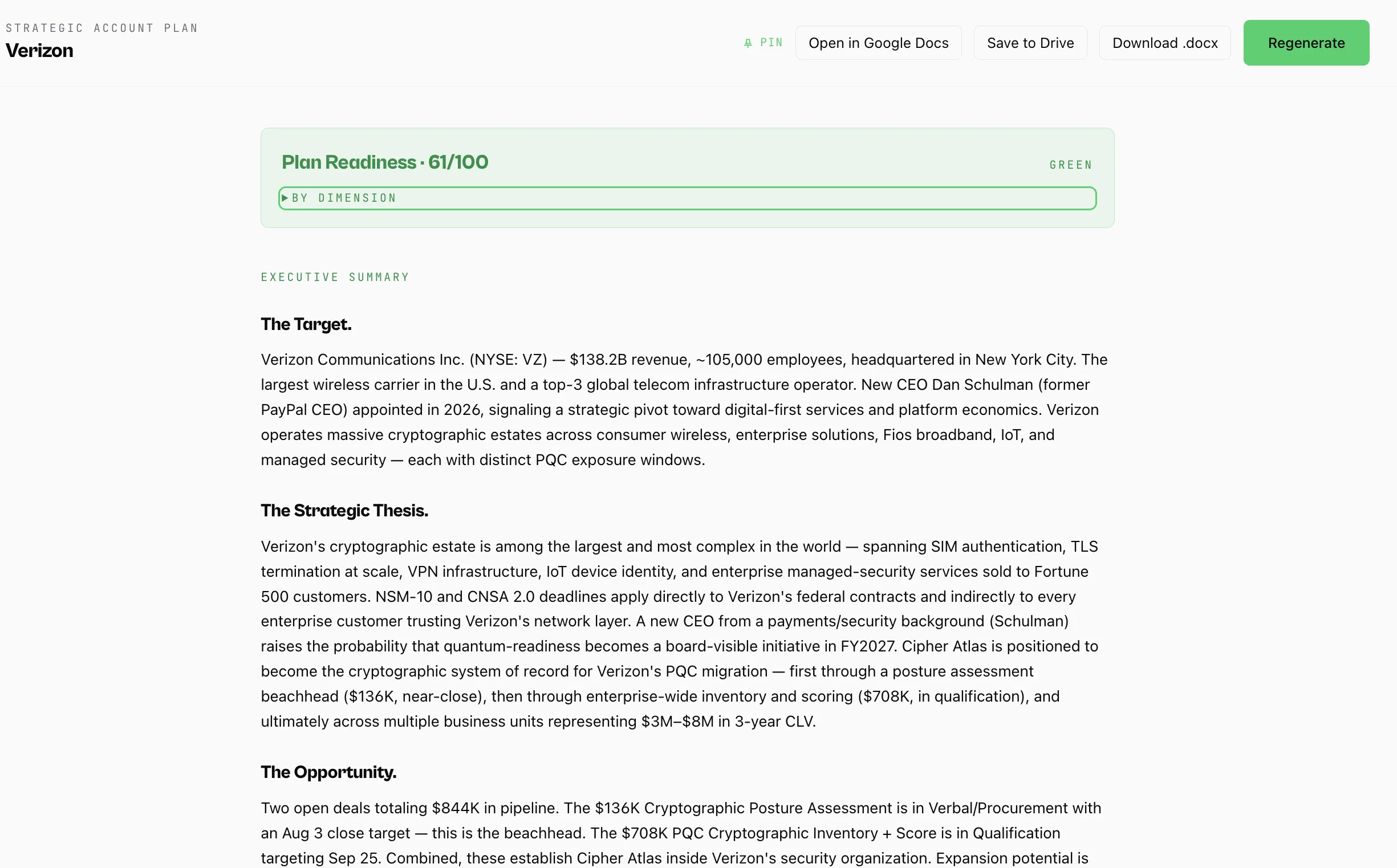
Accounts · Strategic account plan · Verizon
Enlarge
Live product
Proven by hand before it was software
A method built in the seat you're taking.
Twenty years leading revenue teams and training their leaders, now running on your own data every week.
Results Jason led as an operator, using the method Management OS now runs. They are his results, not Management OS customer results.
Read-only to your CRM. Management OS never creates, changes or deletes a CRM record. No training on customer data. Trust & Security · Sub-processors · DPA
Questions
Questions new CROs ask
Is 90 days enough to change a forecast?
Enough to change how the forecast is built, and rarely enough to change the number itself. In 90 days you can know which deals and sellers are real, run a coaching rhythm through your managers and show the board the method behind your call.
Will it work with the CRM I inherited?
Yes. It connects read-only to HubSpot, Salesforce, Pipedrive, Zoho CRM, Keap, monday.com, Attio or a spreadsheet, and maps your stage names to one standard so an inherited pipeline is read consistently.
I report to an operating partner. Does that change anything?
The same system applies, and the operating partner will grade the rhythm behind the number as closely as the number. Management OS for PE-backed CROs lays out a 100-day plan you can show the sponsor.
What does it cost after the trial?
From $1,250 a month. Leader covers you and up to 3 people, Team ($1,800) up to 5, and Org ($3,000) up to 10, any mix of managers and reps, so Org is the package for coaching through your managers. Annual billing costs less, and there is no platform fee. The 30-day trial runs on the package you choose and continues on it unless you cancel before day 30.
 Jason Mesiarik