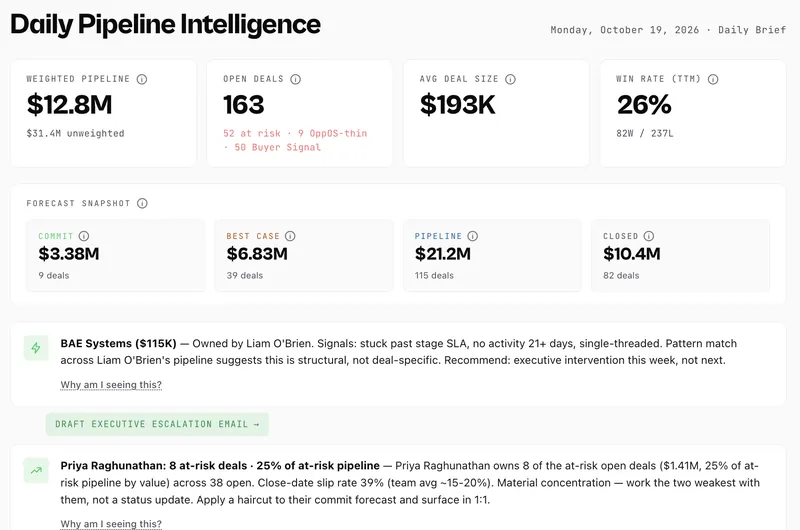
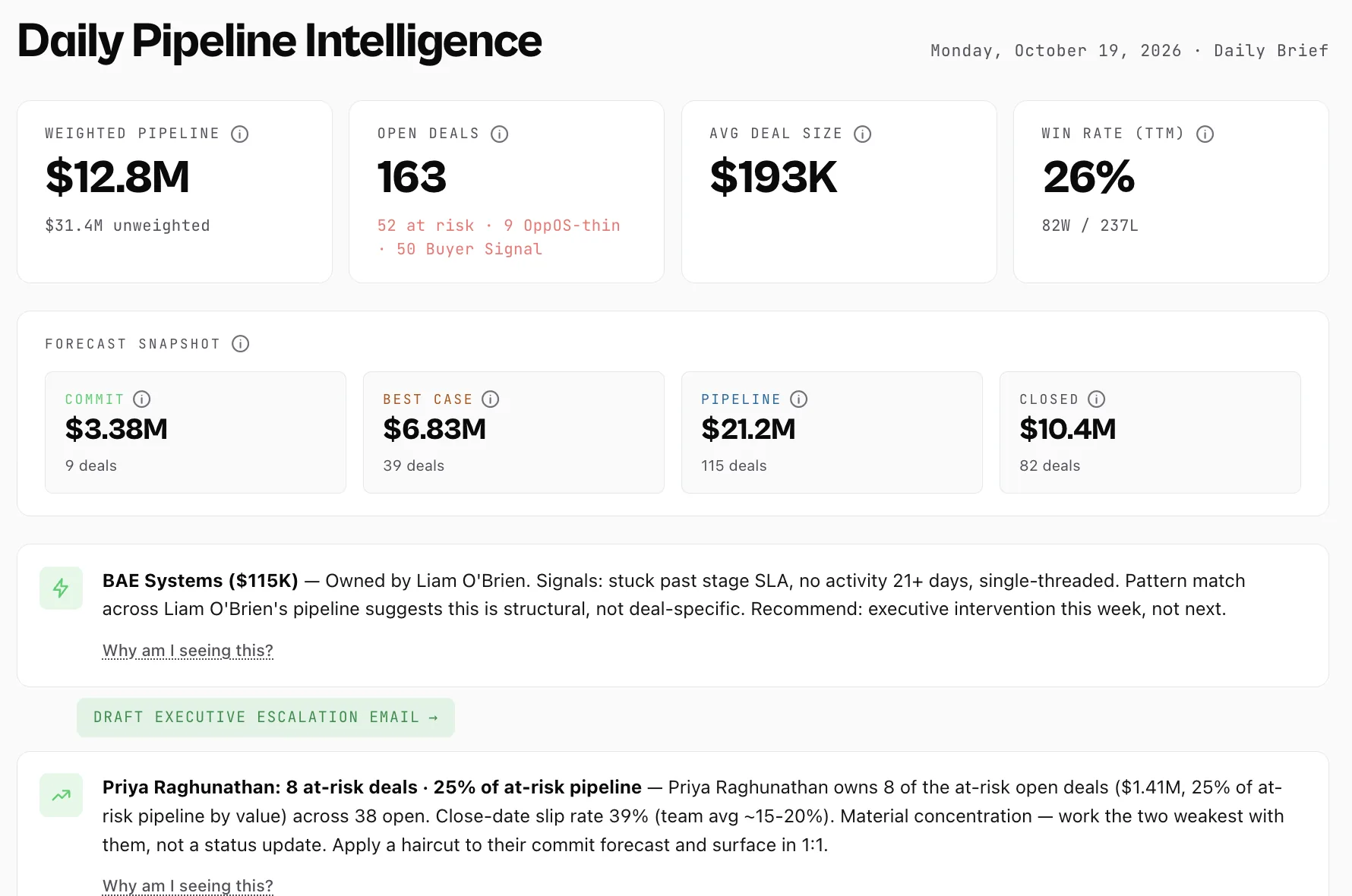
Three stalled deals, the same notes to a model and to Management OS. One sells the deal. The other finds the rep pattern and preps the coaching conversation. Watch on YouTube (opens in a new tab)
Every screen here is the live product, on our demo workspace, Cipher Atlas. Its CRM uses real company names as accounts; none of those companies is a Management OS customer.
The weekend build
Should you build an AI sales agent yourself?
You can, and a weekend gets you something genuinely useful. The trouble starts after that.
You'd connect Claude or GPT to your CRM and prompt it to summarize deals, flag the quiet ones and draft a follow-up. In a weekend (two, if you're also running the company) it works.
Then it sits there being almost right. Confidently flagging the wrong deals. Coaching advice that reads like a blog post. A summary of what happened, when you needed to know what to do. Every time you tune it, you learn what Jason learned running revenue teams: the model is the easy part.
A weekend of building
What you'd have
A CRM-connected agent that summarizes deals and activity
Flags on the deals that look quiet
A drafted follow-up email or two
A summary of what happened, on request
Something you now have to maintain, forever, between everything else
What a weekend can't encode
What it still wouldn't know
The diagnostic method that separates a stalled deal from a dead one
The coaching model that names why a rep will miss before the miss
The weekly rhythm that runs Monday to Sunday without your willpower
The failure patterns from scaling revenue teams, learned the expensive way
The judgment to show you the one move that matters this week
The gap between the two columns is knowing which signal matters and what to do about it. A prompt can't reach it. Management OS runs it.
Why the gap doesn't close on its own
Three things that never show up in a prompt library.
You get all three without building them.
Logic a prompt library can't see. The scoring, diagnostic and coaching logic runs inside the product, out of reach of any prompt library.
Failures included. Built from what worked and what didn't: both sides of the record.
Graded evidence. A deal read grades each part of the deal on a 0 to 4 evidence scale, so the rep's word alone counts only as seller belief.
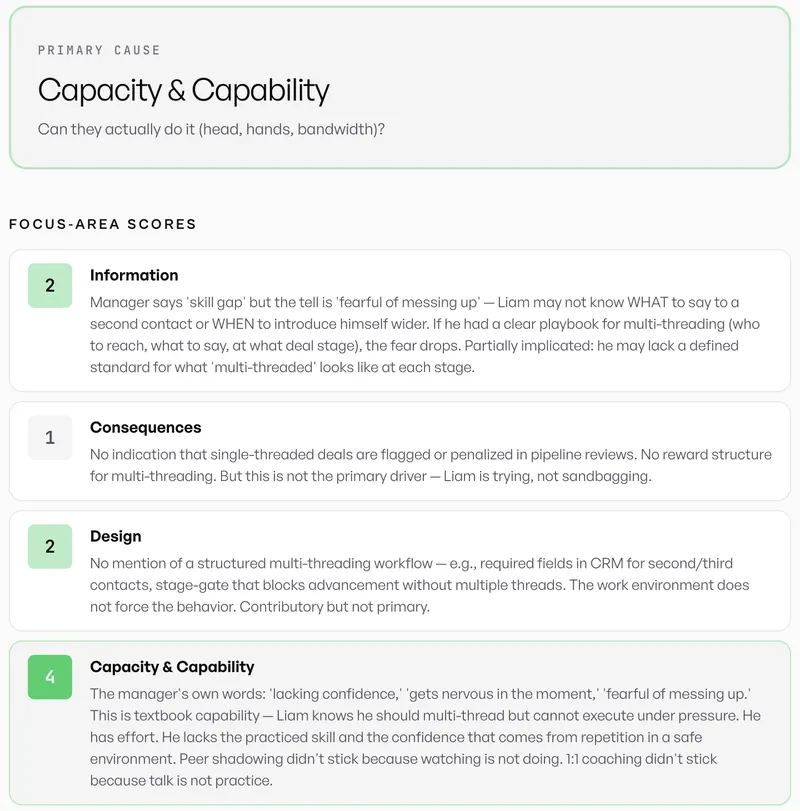
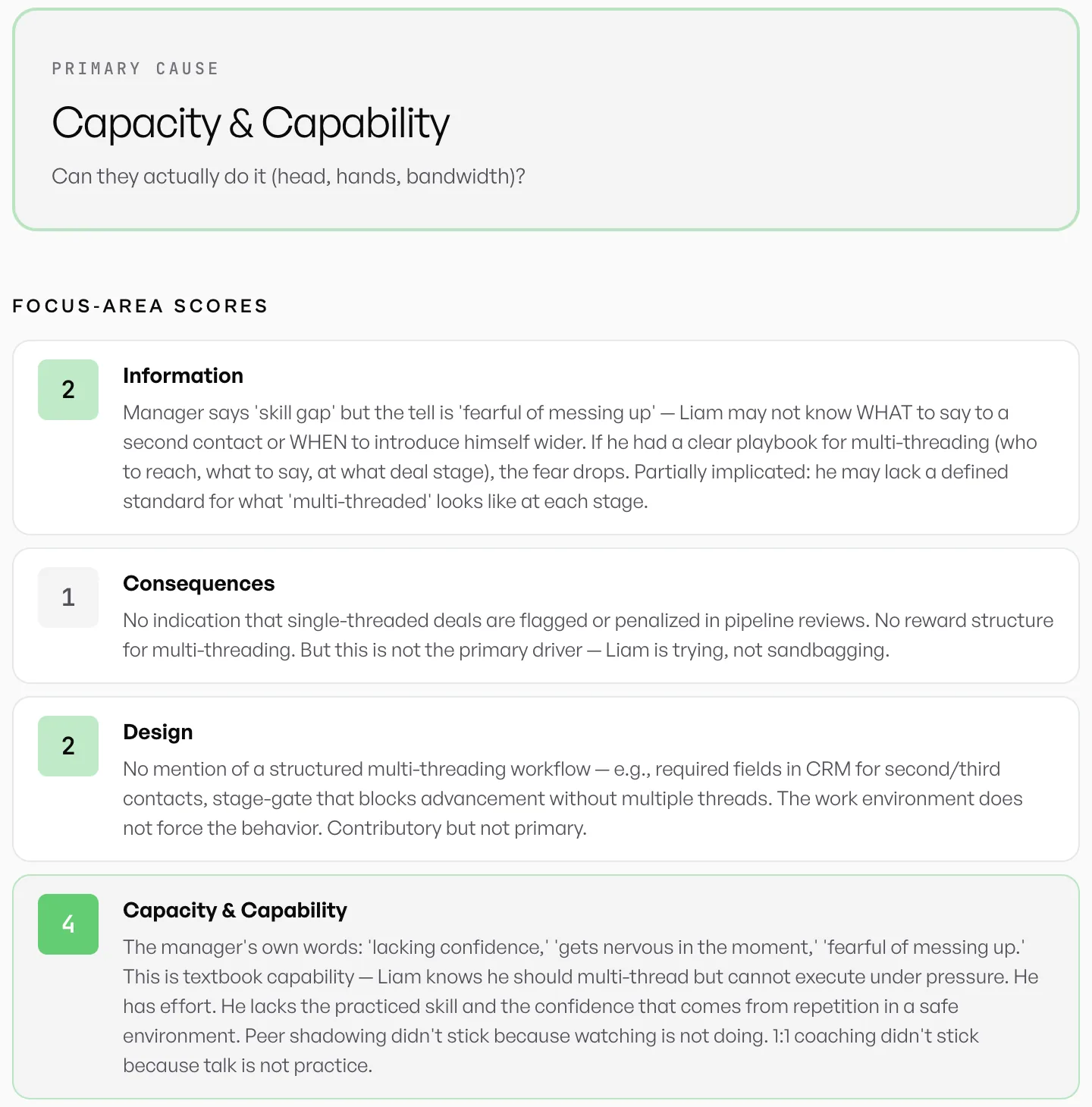
Why a rep will miss, named before the miss.
A weekend build summarizes the pipeline. This reads the cause behind one rep's misses: Liam knows he should reach a second contact but can't yet do it under pressure. The coaching plan it leads to sets the next check, a Friday 1:1 for four weeks counting how many of his 11 deals have two engaged contacts.
Coaching · Diagnosis · Liam O'Brien
Enlarge
Live product
The real cost of building
Your weekends, or 15 minutes.
Building go-to-market AI is a staffed job, even where the model is made. Anthropic is hiring a Staff Software Engineer to build agents for its own go-to-market work (inbound, outbound and pipeline management) at $320K to $405K a year (public posting, checked 3 November 2026). That is a different job from this one, and it prices the skill. At your stage, your attention is the scarcest asset in the company.
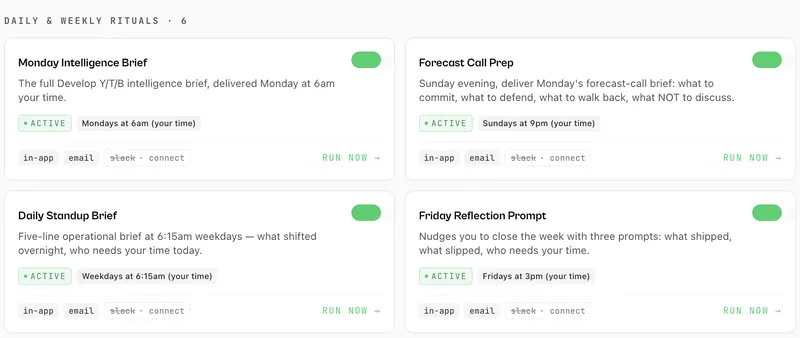
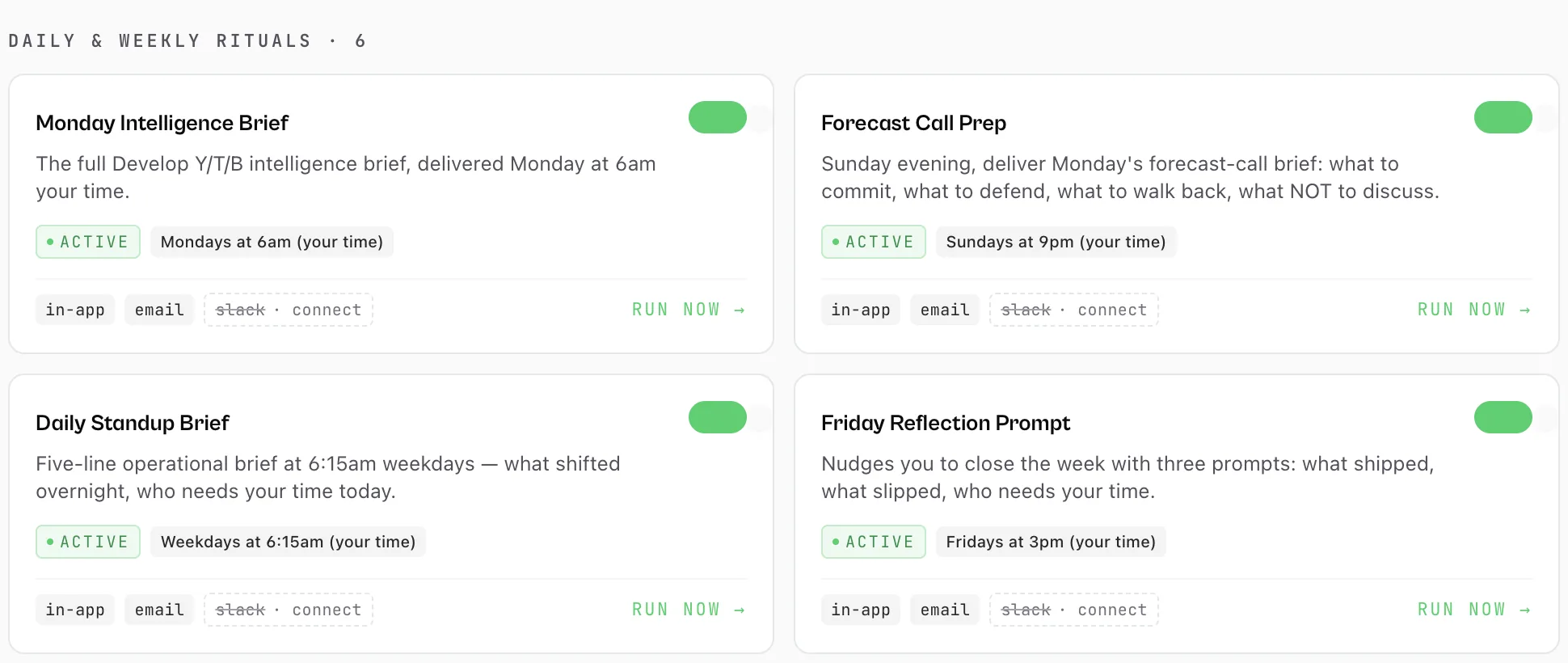
The rhythm a weekend build never gets to is already running, in the app and by email: the Monday Intelligence Brief at 6am, Forecast Call Prep on Sunday at 9pm, the Daily Standup Brief at 6:15am on weekdays and the Friday Reflection Prompt at 3pm.
Automations · Daily and weekly rituals
Enlarge
Live product
The trial, in plain language
30 days free. Judge it against what you'd build.
30 days free on the package you choose at sign-up (Leader, Team or Org), with your team and your data. Leader covers you and up to 3 people, Team up to 5, and Org up to 10.
Priced by the people you manage, with no seat charge. On day 30 the trial becomes the package and billing you chose at sign-up, unless you cancel: from $1,000 a month billed yearly, or $1,250 billed monthly. See every package.
Connect your CRM, read-only: you grant access, we read. Management OS reads your pipeline, team and calendar.
About minute 15: your first brief
The thing you'd be building, on your own pipeline. Then run it against your own instinct for four weeks.
Before day 30: you decide
Cancel and pay nothing, or keep going on your package.
Proven by hand before it was software
The layer you'd build if you had the time. Already built.
The sales management operating system built for leaders and used by their teams: insights, coaching and actions to develop yourself, your team and your business. Jason Mesiarik built it from twenty years of leading revenue teams: the patterns are lived, then systematized into a patent-pending platform.
Results Jason led as an operator, using the method Management OS now runs. They are his results, not Management OS customer results.
Read-only to your CRM. Management OS never creates, changes or deletes a CRM record. No training on customer data. Trust & Security · Sub-processors · DPA
Questions
Should you build or buy AI for sales leadership?
Can I build this with ChatGPT or Claude?
You can build a useful assistant. The harder part is the operating system around it: the CRM sync, 59 automations on by default, and the brief that arrives before you ask. Management OS also works inside Claude and ChatGPT.
Can I extend it from my own tools?
In part, yes. Deal reads and coaching plans work inside Claude and ChatGPT, Docs export to your Google Drive, and anything that can post to its webhook can push data in.
How long does setup take?
About 5 minutes to connect a CRM, and your first brief in about 15 minutes. Card required. Cancel before day 30 and pay nothing.
On day 30 the trial becomes the package and billing you chose at sign-up, unless you cancel: from $1,000 a month billed yearly, or $1,250 billed monthly. See every package.